Dino
Bever
Mr.
Dacey
Astronomy
Period 4
January
10, 2014
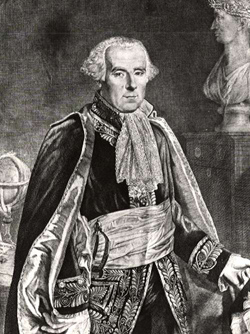
Simon Pierre Laplace
Pierre-Simon , Marquis de Laplace
was born on March 23rd, 1749, in Beaumount-en-Auge, Nromandy,
France, HE died on March 5th, 1827 at the age of 78 in Paris. He was
an extremely well known French Mathematician, Astronomer, and Physicist who is
best known for his investigation to the stability of the solar system. Laplace
successfully accounted for all the observed abnormalities of the planets from
their theoretical orbits by applying Sir Isaac Newton’s theory of gravitation to
the solar system, and he developed a conceptual view of evolutionary change in
the structure of the solar system. He also demonstrated the usefulness of probability
for interpreting the scientific data. Simon Pierre Laplace grew up poor, being the
son of a peasant farmer; and little is known of his early life with the
exception that he demonstrated great mathematical adroitness at the military
academy of Beaumont. In 1766 Laplace entered the University of Caen, but left
only a year later for Paris without a degree from the University. He taught at the Ecole of Militaire with a
letter of recommendation by Jean d’Alembert from 1769-1776.
Laplace began his life’s work, applying
Newtonian Gravitation to the Solar System in 1773 when he began to wonder why
Jupiter’s orbit seemed to be constantly shrinking while Saturn’s appeared to be
expanding. In 1773 Simon won the associate membership in the French Academy of
sciences because of his astronomical advancements, after he announced the invariability
of planetary motions. In 778 Laplce proved after a careful examination of all
planetary perturbations that all eccentricities and inclinations of planetary
orbits to each other will always remain small, constant, and self-correcting as
opposed to the theory that Newton had put into place, that the effects of
perturbations were therefore conservative and periodic, not cumulative, and
disruptive. In 1796 Laplace published Exposition
du Systéme du monde a moderately popular book about his work on celestial mechanics;
the book also included his “Nebular Hypothesis” his theory on the origin of the
Solar System.
Simon pierre Laplace was one of the
greatest mathematicians and astronomers to have lived his work in removing any
uncertainty within the theoretical description of the forming of the Solar
System. His work on Bayesian Probability was ground breaking and is still
uniformly taught to students at college. During his time as president of the
Board of Longitude, after escaping imprisonment and execution during the French
Revolution he assisted in the organization of the Metric System. Simon Pierre
Laplace touched all of our lives in some subtle way even if we don’t realize
it, had he not done some of the things he had we would be living in a different
world.